
What is the difference between robotics and automation in a laboratory?
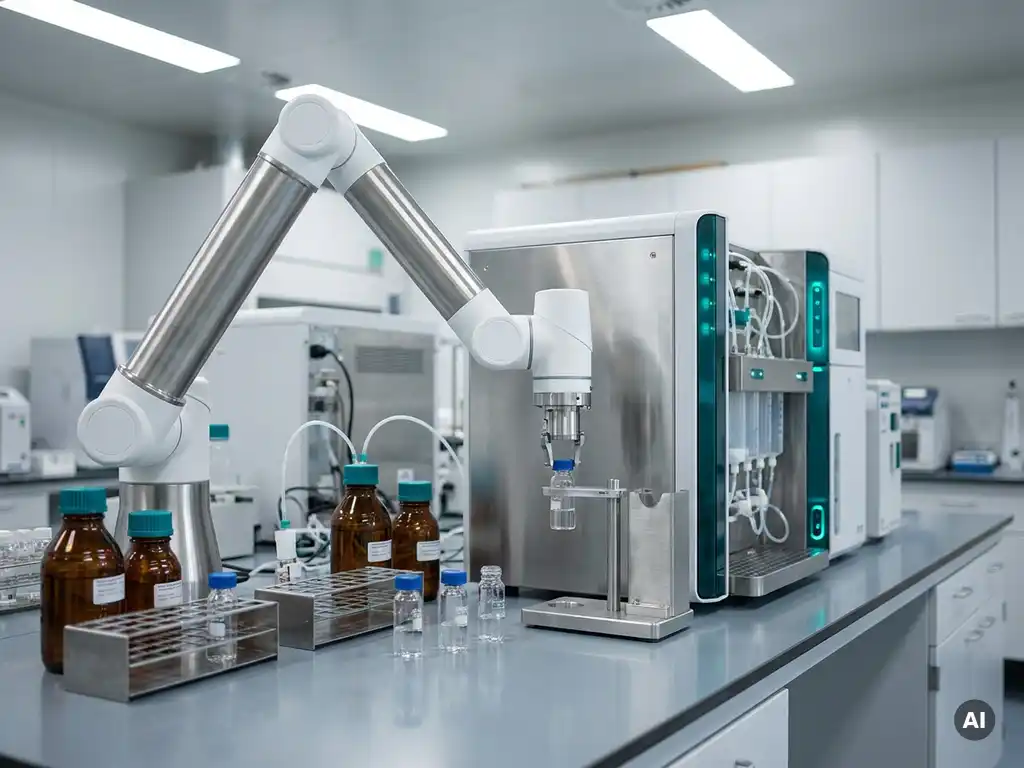
Robotics and automation are related but distinct concepts in a laboratory setting. Laboratory automation refers to systems that perform repetitive, rule-based tasks without human intervention, following fixed programmed sequences. Laboratory robotics goes further, using articulated mechanical arms or mobile platforms capable of adapting to variable conditions, handling diverse tasks, and operating across multiple workstations. The practical difference matters most when deciding which technology fits your workflow, budget, and analytical goals. The sections below address the most common questions laboratories raise when evaluating these two approaches.
How does laboratory automation differ from laboratory robotics?
Laboratory automation uses pre-programmed systems to execute fixed, repetitive tasks consistently and without human input. Laboratory robotics uses physically articulated machines that can replicate a broader range of human movements, often combining sensors and software to adapt to changing conditions. Automation is task-specific; robotics is more flexible and general-purpose.
A practical way to distinguish the two is to think about what happens when something unexpected occurs. An automated solid-phase extraction system, for example, will follow its programmed sequence precisely regardless of context. It will dispense solvent, apply vacuum, collect fractions, and repeat. A robotic system, by contrast, might detect that a vial is misaligned and adjust its grip accordingly. That adaptive capacity is the defining characteristic of robotics.
In most analytical laboratories, the two categories overlap significantly. Many modern platforms combine automated workflows with robotic components, such as a robotic arm that loads samples into an otherwise fully automated extraction system. This convergence means the boundary between the two is increasingly blurred in practice, but the underlying distinction in flexibility and adaptability remains useful when selecting the right system for a specific application.
For laboratories focused on environmental contaminant analysis, the majority of daily needs fall firmly within the automation category. Extraction, purification, concentration, and cleanup of samples for dioxins, PCBs, or PFAS analysis all follow well-defined, repeatable protocols that are ideally suited to dedicated automated platforms rather than general-purpose robotic systems.
What tasks are best suited to laboratory automation?
Laboratory automation excels at tasks that are repetitive, high-volume, protocol-driven, and sensitive to human error. These include sample extraction, solid-phase extraction, solvent evaporation, sample concentration, liquid handling, and cleanup workflows. Any task with a defined sequence of steps that must be executed consistently across dozens or hundreds of samples is a strong candidate for automation.
The core advantage of lab automation in these contexts is reproducibility. When a human analyst manually performs twenty SPE extractions in a day, fatigue, distraction, and minor technique variations introduce variability. An automated system performs each extraction identically, which is critical for laboratories operating under ISO 17025 accreditation or regulatory frameworks that demand demonstrated method reproducibility.
High-throughput sample preparation for persistent organic pollutants is a particularly well-suited application. Workflows for dioxins, PCBs, PBDEs, and PFAS involve multiple sequential steps, each requiring precise solvent volumes, controlled flow rates, and exact timing. Automating these steps eliminates the most common sources of analytical error and frees analysts to focus on data review and interpretation rather than manual pipetting and fraction collection.
Other tasks well suited to lab workflow automation include nitrogen blowdown and vacuum concentration for final volume adjustment before instrument injection, large-volume water extraction using disk- or cartridge-based SPE, and solvent extraction of solid matrices using systems based on established principles such as the Randall method. Each of these represents a defined, repeatable protocol that benefits directly from automated execution.
When does a laboratory actually need robotics?
A laboratory genuinely needs robotics when its workflows require physical adaptability across diverse, unpredictable tasks that cannot be reduced to a fixed programmed sequence. This typically applies to high-diversity research environments, drug discovery operations processing thousands of structurally varied compounds, or facilities running fully integrated sample-to-result pipelines across multiple instrument platforms.
For most environmental and food safety testing laboratories, the threshold for true robotics is rarely reached. The analytical workflows in these settings, while technically demanding, are highly structured. The same extraction protocol applies to every soil sample, the same cleanup sequence applies to every food matrix run through a dioxin analysis, and the same SPE method applies to every water sample tested for PFAS. These are exactly the conditions where dedicated automated systems outperform general-purpose robotics on both cost and reliability.
Robotics becomes genuinely valuable in laboratories that need to integrate multiple distinct workflows into a single continuous pipeline. If a laboratory must automatically move samples between an extraction unit, a cleanup station, a concentration system, and an autosampler without any human touchpoints, a robotic transport and handling layer may be justified. In these cases, robotics serves as the connective tissue between automated modules rather than replacing those modules.
The decision also depends on volume and diversity. A contract laboratory running a single well-validated method at high throughput will almost always achieve better return on investment from a purpose-built automated system. A research facility running dozens of different methods on unpredictable sample types may find that a flexible robotic platform justifies its higher cost and complexity.
What are the main types of laboratory automation systems?
The main types of laboratory automation systems are liquid handling systems, solid-phase extraction platforms, extraction and concentration systems, and integrated sample preparation platforms. Each category addresses a distinct stage of the analytical workflow, and laboratories typically deploy multiple types in sequence to achieve end-to-end automated sample preparation.
Extraction and concentration systems
These systems automate the initial step of isolating target compounds from a sample matrix. For solid and semi-solid samples, solvent extraction systems based on principles such as the Randall method can process multiple samples simultaneously using minimal solvent volumes. Concentration systems, including vacuum centrifuges and parallel evaporation platforms using nitrogen sweeping, then reduce the extract to the precise volume required for instrument injection. Both steps are critical for maintaining recovery and reproducibility.
Solid-phase extraction platforms
Automated SPE systems handle the extraction and cleanup of liquid samples, including water, extracts, and dissolved matrices. These platforms range from high-capacity batch processors capable of running dozens of cartridges simultaneously to large-volume disk-based systems designed for environmental water samples. The best systems for PFAS and other emerging contaminants feature fully inert flow paths to prevent analyte loss or contamination from system components.
Fully automated cleanup systems
For complex matrices requiring multi-layer purification, such as food, feed, soil, and biological samples analyzed for dioxins or PCBs, fully automated cleanup platforms perform the entire post-extraction purification sequence. These systems apply sequential chromatographic cleanup steps, managing solvent flows, column switching, and fraction collection without analyst intervention. The result is a purified extract ready for high-resolution mass spectrometry analysis.
How do automation and robotics affect solvent use and contamination risk?
Automated sample preparation systems significantly reduce organic solvent consumption compared to manual methods and eliminate the most common sources of cross-contamination. Purpose-built automated platforms achieve this through closed-system designs, precise solvent metering, and the physical separation of samples from system components throughout the workflow.
In manual sample preparation for persistent organic pollutants, solvent use can be substantial, and analysts are directly exposed to the solvents throughout the process. Automated systems designed for environmental contaminant analysis can reduce solvent consumption to less than 100 ml per sample and eliminate the need for hazardous solvents such as dichloromethane entirely. This reduction benefits both laboratory safety and environmental sustainability, two priorities that are increasingly central to laboratory procurement decisions in 2026.
Cross-contamination is a particular concern in laboratories analyzing trace-level contaminants such as dioxins and PFAS, where carryover between samples can produce false positives and compromise analytical credibility. Automated systems address this risk in two ways. First, by ensuring that samples do not come into direct contact with the system’s internal components, carryover pathways are physically eliminated. Second, consistent automated cleaning cycles between runs maintain system integrity across high-throughput batches.
For PFAS analysis specifically, the materials used in the flow path matter as much as the automation itself. Systems featuring fully inert, Teflon-free flow paths prevent PFAS adsorption or leaching from system components, which would otherwise introduce background contamination that undermines the entire analysis. This is a design consideration that separates purpose-built analytical automation from general-purpose robotic liquid handlers adapted for this application.
Should a lab invest in automation or robotics first?
Most laboratories should invest in automation before robotics. Dedicated automated systems for specific, high-frequency workflows deliver faster return on investment, require less integration complexity, and address the most immediate sources of inefficiency and error. Robotics becomes the right investment only after core workflows are already automated and the remaining bottleneck is physical sample transport or cross-platform integration.
The practical starting point is identifying which manual steps consume the most analyst time, introduce the most variability, or create the greatest compliance risk. In environmental and food safety testing laboratories, these steps are almost always in sample preparation: extraction, cleanup, and concentration. Automating these steps first produces immediate, measurable gains in throughput, reproducibility, and analyst capacity.
Budget is also a relevant factor. A purpose-built automated SPE system or fully automated cleanup platform typically represents a lower capital investment than a general-purpose robotic workstation, while delivering superior performance for its specific application. For laboratories with constrained capital budgets, this makes targeted automation the more defensible investment to justify to management or procurement.
Once core automated sample preparation is in place, the case for robotics grows if the laboratory wants to achieve lights-out operation, integrate multiple automated modules into a continuous pipeline, or handle a sufficiently diverse range of sample types that a single automated platform cannot cover. At that point, robotics adds genuine value as a coordination layer rather than a replacement for the specialized automated systems already in place.
How DSP-Systems supports laboratory automation decisions
DSP-Systems helps analytical laboratories across Europe and North America implement the right automated sample preparation solutions for their specific contaminant analysis workflows. Rather than offering a one-size-fits-all approach, DSP-Systems matches laboratories with purpose-built automated platforms based on their matrices, target analytes, throughput requirements, and regulatory obligations. Key capabilities include:
- Supply and distribution of fully automated cleanup systems for dioxins, PCBs, PBDEs, and PCNs across food, feed, soil, water, and air matrices, using less than 100 ml of solvent per sample without dichloromethane
- High-throughput automated SPE platforms for PFAS, pesticides, hormones, PAHs, and other emerging contaminants, with fully inert, Teflon-free flow paths
- Large-volume water extraction systems and multi-channel AutoEmpore configurations for flexible environmental monitoring workflows
- Solvent extraction systems and concentration solutions that integrate seamlessly with automated cleanup platforms
- Method development, validation support, and turnkey laboratory setup for laboratories building or scaling internal contaminant analysis capabilities
- Outsourced analytical services through ISO 17025-accredited partner laboratories, providing internationally recognized results for laboratories not yet ready to bring analysis fully in-house
If your laboratory is evaluating automated sample preparation systems or looking to reduce solvent use, eliminate cross-contamination risk, and improve throughput for environmental contaminant analysis, contact DSP-Systems to discuss which platform best fits your workflow.
Veelgestelde vragen
How do I know if my current manual workflow is a good candidate for automation?
The clearest indicators are high sample volumes, repetitive multi-step protocols, recurring reproducibility issues, and analyst time lost to hands-on sample preparation. If your team is spending several hours per day on extraction, cleanup, or concentration steps that follow the same sequence every time, those workflows are strong candidates for automation. A useful first step is to log analyst time per sample type and identify where variability in results is most likely originating — those pain points almost always point directly to the steps that automation can address most effectively.
Can automated sample preparation systems be validated under ISO 17025 or regulatory frameworks?
Yes, and in many cases automation makes the validation process more straightforward rather than more complex. Because automated systems execute each step identically, method validation data collected on the system is highly reproducible, which satisfies the repeatability and intermediate precision requirements of ISO 17025 and equivalent regulatory frameworks. The key is to validate the automated method as implemented on the specific platform, including any solvent volumes, flow rates, and timing parameters programmed into the system, and to document the system’s performance during routine quality control checks.
What should I watch out for when evaluating automated SPE systems for PFAS analysis?
The most critical factor is the composition of the system’s internal flow path. Many general-purpose liquid handling and SPE systems use PTFE or other fluoropolymer tubing and fittings that can both adsorb PFAS from samples and leach background PFAS contamination into extracts, undermining the entire analysis. Look specifically for systems designed with fully inert, Teflon-free flow paths, and ask vendors for documented background PFAS levels measured in system blanks. Carryover performance between high-concentration and low-concentration samples is the second critical specification to request data on before committing to a platform.
How long does it typically take to implement and get up and running with a new automated sample preparation system?
Implementation timelines vary depending on the complexity of the platform and how well-defined the target method already is, but most laboratories can expect to be running validated samples within four to twelve weeks of instrument installation. Systems supplied with pre-configured methods for established contaminant classes — such as dioxins, PCBs, or PFAS — typically reach operational readiness faster than those requiring full method development from scratch. Vendor support for installation, method transfer, and initial validation runs significantly compresses this timeline, so it is worth confirming the scope of post-sale technical support before purchasing.
Is it possible to automate only part of a workflow while keeping other steps manual?
Absolutely, and this is in fact how most laboratories begin their automation journey. Automating a single high-impact step — such as SPE cleanup or nitrogen concentration — delivers immediate gains in reproducibility and throughput without requiring a complete workflow overhaul. The important consideration is ensuring that the automated module accepts samples in a format compatible with your upstream manual steps and delivers output in a format compatible with your downstream instrumentation. Modular automation, where each platform handles a discrete stage and integrates with the others through standardized vial or tube formats, is a practical and cost-effective approach for laboratories scaling automation incrementally.
What happens if a sample matrix is unusual or outside the scope of the system's standard method — can automated systems handle that?
Most purpose-built automated sample preparation systems offer configurable parameters — solvent volumes, flow rates, wash steps, and fraction collection points — that can be adjusted to accommodate different matrices within the same analyte class. For genuinely novel matrices, method development work is required, but this is done once and then locked in as a repeatable automated protocol. The advantage over manual methods is that once a modified protocol is validated for a new matrix, the system executes it consistently every time, eliminating the analyst-to-analyst variability that makes manual method adaptation particularly risky in regulated laboratory environments.
How does automating sample preparation affect staffing and analyst roles in practice?
Automation does not reduce the need for skilled analysts — it redirects their expertise toward higher-value activities. Time previously spent on manual pipetting, fraction collection, and solvent handling shifts toward instrument oversight, data review, quality control interpretation, and method development. In high-throughput laboratories, this reallocation often allows the same team to handle significantly larger sample volumes without adding headcount, which is one of the strongest return-on-investment arguments for automation in contract and commercial testing environments.
Gerelateerde artikelen
- Can automated sample preparation reduce solvent consumption?
- What types of samples can be processed with automation?
- How do you validate an automated sample preparation method?
- What laboratory workflows benefit most from automation?
- How does laboratory automation shorten analytical turnaround times?
Deze inhoud is gegenereerd met behulp van AI en kan fouten bevatten.