

What maintenance does an automated sample preparation system require?
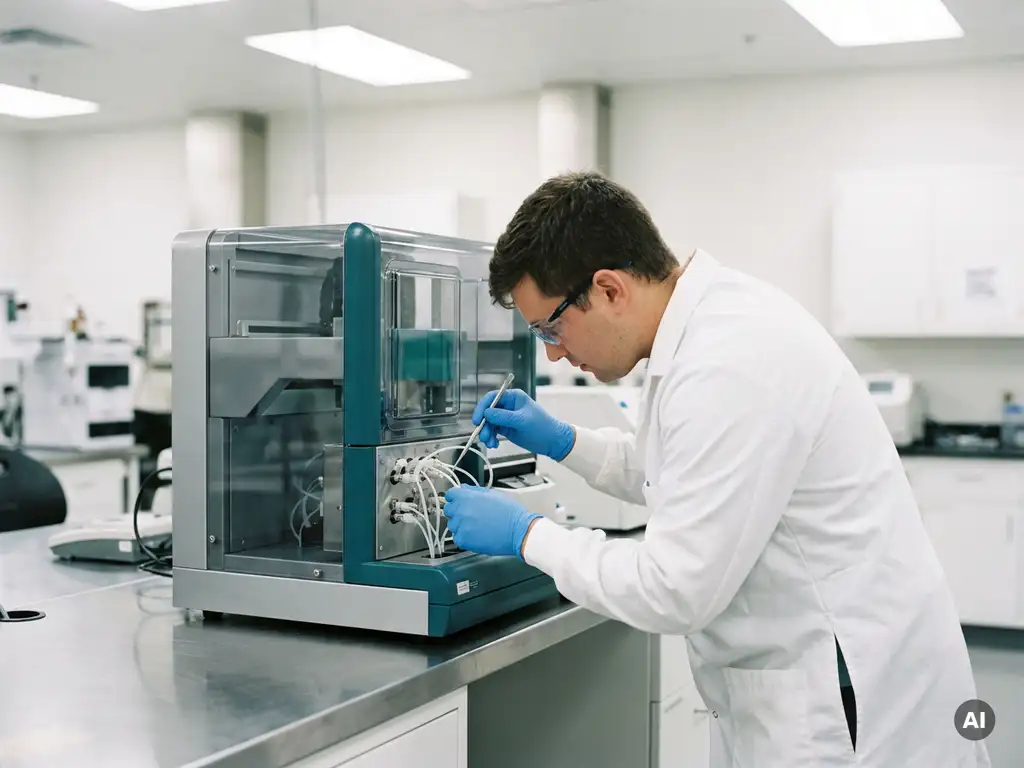
Automated sample preparation systems require a combination of daily operator checks, periodic preventive maintenance, and scheduled servicing by a qualified engineer. The exact frequency depends on the system type, sample throughput, and the matrices being processed, but most laboratories working with environmental contaminants should plan for structured maintenance intervals rather than reacting to failures. The sections below address the most common questions laboratory managers ask about keeping these systems running reliably and in compliance.
How often should an automated sample preparation system be serviced?
Most automated sample preparation systems should undergo a formal preventive maintenance service at least once per year, with higher-throughput laboratories scheduling two service visits annually. Daily and weekly operator checks run alongside this calendar, ensuring that minor issues are caught before they affect analytical performance or system uptime.
The right service interval depends on several practical factors:
- Sample volume and throughput: A system processing dozens of samples per day accumulates wear far faster than one running occasional batches. High-throughput laboratories analyzing dioxins, PCBs, or PFAS across multiple matrices should lean toward biannual professional servicing.
- Matrix complexity: Samples containing high lipid content, suspended solids, or aggressive chemical residues place greater stress on fluidic components and sorbent pathways.
- Manufacturer recommendations: Always treat the manufacturer’s service schedule as a minimum, not a suggestion. Deviating from it can affect warranty coverage and ISO 17025 compliance documentation.
- Regulatory context: Laboratories operating under accreditation schemes are typically required to demonstrate that equipment is maintained according to a documented schedule.
A practical approach is to build maintenance intervals into the laboratory’s quality management system, so service dates are triggered automatically rather than left to individual judgment.
What routine maintenance tasks does the operator perform?
Routine operator maintenance for an automated sample preparation system covers daily visual inspections, regular cleaning of contact surfaces and waste pathways, verification of solvent levels and pump function, and software log reviews. These tasks take minutes but protect both data integrity and equipment longevity.
Operators working with systems such as fully automated cleanup platforms or SPE-based extraction systems should build the following into their daily and weekly workflows:
- Daily checks: Inspect tubing connections and fittings for leaks or discoloration; confirm solvent reservoir levels; verify that waste containers have sufficient capacity; check that the system completes its self-diagnostic or initialization routine without errors.
- After each run: Flush solvent pathways according to the system’s protocol; remove and dispose of used cartridges or columns; wipe down any accessible external surfaces that may have come into contact with sample residue.
- Weekly tasks: Inspect needle assemblies and injection ports for blockages or corrosion; review the system’s run log for flagged errors or anomalies; check valve seals for signs of wear; confirm that all sensors and detectors respond correctly during the system’s self-test.
- Monthly tasks: Replace any consumables that have reached their rated cycle count; calibrate pressure sensors if the system provides that function; clean filters in solvent delivery lines.
Keeping a written or digital log of every operator-level task completed is not just good practice. It forms the audit trail that accredited laboratories need to demonstrate ongoing equipment control.
What parts of the system are most prone to wear or fouling?
The components most prone to wear or fouling in an automated sample preparation system are the pump seals and pistons, valve seats and rotor seals, needle assemblies, solvent delivery tubing, and any filtration elements in the flow path. These are the points where mechanical stress and chemical exposure combine most intensely.
Fluidic and mechanical components
Pump seals degrade over time, particularly when the system handles a broad range of organic solvents. As seals wear, they can introduce micro-leaks that affect reproducibility without triggering an obvious alarm. Valve rotor seals experience similar attrition from repeated switching cycles. In systems designed with inert, Teflon-free flow paths, the seal materials are selected to resist the full range of organic solvents, but they still have finite service lives that should be tracked.
Needle assemblies, especially in systems that pierce septum-sealed vials, accumulate deposits from sample matrices over time. Partially blocked needles cause inconsistent injection volumes and are a common root cause of unexplained carryover between runs.
Filtration and sorbent pathways
Inline filters and frits are designed to protect downstream components from particulate matter, but they foul progressively with use. A partially blocked frit increases backpressure, which stresses pump seals and can distort flow rates. In systems processing complex environmental matrices such as soil, sludge, or high-fat food samples, frit replacement should be treated as a routine consumable task rather than a reactive one.
Sorbent cartridges and cleanup columns are single-use in most workflows, but the ports and manifolds that hold them can accumulate residue if not cleaned after each run. This is particularly relevant for PFAS analysis, where even trace contamination in the system’s wetted surfaces can compromise results.
When should maintenance be handled by a service engineer?
Maintenance should be escalated to a qualified service engineer whenever it involves internal mechanical components, firmware or software updates, pump rebuild or replacement, valve seat replacement, or any repair that requires opening the instrument’s protected enclosures. Operators should not attempt these tasks, as incorrect reassembly can introduce contamination or compromise analytical performance.
Beyond scheduled annual or biannual visits, specific triggers that warrant an unscheduled service call include:
- Persistent pressure alarms that do not resolve after checking for blocked frits or tubing kinks
- Unexpected carryover between samples that cannot be resolved by flushing protocols
- Erratic or drifting flow rates despite operator-level checks
- Error codes that the operator manual classifies as requiring qualified service
- Any physical damage to internal components identified during routine inspection
- Failure of the system’s self-diagnostic routine to complete successfully
For laboratories operating under ISO 17025 accreditation, it is important that service engineers provide a signed service report documenting every action taken. This report becomes part of the instrument’s qualification record and is often reviewed during external audits.
How does proper maintenance affect cross-contamination risk?
Proper maintenance directly reduces cross-contamination risk by ensuring that solvent pathways, needle assemblies, valves, and sample-contact surfaces remain clean, intact, and functioning within specification. Worn or fouled components are the primary technical route through which residues from one sample carry over into the next.
In systems specifically engineered to eliminate cross-contamination, such as the GO-EHT automated cleanup platform where samples do not come into direct contact with the instrument itself, the contamination risk profile is already fundamentally different from conventional systems. However, even in these architectures, the surrounding infrastructure matters. Solvent delivery lines, waste pathways, and manifold ports that are not regularly cleaned can become reservoirs for residual contamination.
For PFAS analysis in particular, contamination control demands exceptional diligence. PFAS compounds adsorb readily onto many surfaces and are notoriously difficult to flush completely. Laboratories performing PFAS analysis should follow dedicated decontamination protocols for any component that may have contacted a high-concentration sample, and should document these steps as part of their quality records.
Maintenance also protects against a subtler contamination pathway: degraded seals or cracked tubing can allow ambient air or solvent vapors to enter the flow path, introducing background signals that are difficult to attribute and even harder to eliminate without identifying the root cause.
What records should a laboratory keep for maintenance compliance?
Laboratories should maintain a complete instrument logbook that records every maintenance action, including the date, the task performed, the operator or engineer responsible, any parts replaced, and the outcome of any post-maintenance verification run. This record set is essential for ISO 17025 compliance, internal quality audits, and demonstrating instrument control to regulatory bodies.
The core records that should be kept for each automated sample preparation system include:
- Installation qualification (IQ) and operational qualification (OQ) records: Documented evidence that the system was installed correctly and performs within specification at commissioning.
- Preventive maintenance logs: Dated entries for every scheduled service, including what was inspected, cleaned, or replaced, and the name of the engineer or technician.
- Corrective maintenance records: Documentation of any unscheduled repairs, including the fault description, root cause if identified, and corrective action taken.
- Calibration certificates: Records for any sensors or measurement functions that require periodic calibration, with traceability to national or international standards.
- Service engineer reports: Signed reports from every professional service visit, retained as part of the instrument’s qualification file.
- Consumable replacement records: Logs of cartridge, frit, seal, and column replacements, including lot numbers where relevant for traceability.
Digital laboratory information management systems (LIMS) make it easier to maintain these records consistently and retrieve them quickly during audits. For laboratories without a LIMS, a structured paper logbook kept with the instrument is an acceptable alternative, provided entries are made contemporaneously and signed.
How DSP-Systems supports your maintenance strategy
DSP-Systems provides more than equipment. The company offers ongoing technical support and training to help laboratories build robust maintenance programs around their automated sample preparation systems. Key ways DSP-Systems can help include:
- Pre-installation programming and configuration of systems such as the GO-EHT cleanup platform and SPE2000 to match your specific analytical workflow and sample matrices
- Operator training courses covering routine maintenance tasks, contamination control, and instrument qualification documentation
- Access to analytical standards and reference materials to support post-maintenance verification runs
- Support for method development and validation when systems are reconfigured or upgraded
- Collaboration with ISO 17025-accredited laboratories to ensure maintenance records meet accreditation requirements
If you are evaluating a new automated sample preparation system or looking for expert support for your existing setup, contact DSP-Systems to discuss your laboratory’s specific needs and throughput requirements.
Veelgestelde vragen
How do I know if my automated sample preparation system needs maintenance sooner than the scheduled interval?
Watch for early warning signs such as gradually increasing backpressure readings, subtle shifts in recovery rates across replicate runs, unexplained baseline noise in downstream analysis, or a rise in flagged errors in the system’s run log. Any of these trends, even if they fall below a hard alarm threshold, should prompt an inspection of wear-prone components such as frits, seals, and needle assemblies rather than waiting for the next scheduled service date. Tracking system performance metrics over time in your instrument logbook makes it much easier to spot these gradual deviations before they affect data quality.
Can we perform pump seal or valve rotor replacements in-house to save time and cost?
It is strongly advisable not to attempt pump seal or valve rotor replacements without formal training and authorization from the manufacturer or a qualified service provider. Incorrect reassembly of these components can introduce dead volumes, micro-leaks, or contamination that are extremely difficult to diagnose afterward, and the repair may void warranty coverage or create gaps in your ISO 17025 qualification documentation. If turnaround time is a concern, discuss a service contract with your supplier that guarantees response times, which is often a more practical solution than attempting complex internal repairs in-house.
What is the best way to verify that the system is performing correctly after a maintenance event?
After any maintenance event, whether operator-level or engineer-led, run a post-maintenance verification using a certified reference material or a well-characterized in-house standard that covers the analytes and matrices relevant to your workflow. Compare recovery, precision, and any pressure or flow metrics against your established acceptance criteria before releasing the system for routine sample analysis. Document the verification run results in the instrument logbook alongside the maintenance record so the two are permanently linked, which is exactly the type of evidence auditors look for under ISO 17025.
How should we handle maintenance scheduling during periods of high sample throughput when we cannot afford downtime?
The most effective strategy is to build preventive maintenance into planned low-activity windows, such as the end of a reporting period or before a known surge in sample submissions, rather than scheduling it reactively. Keeping a small stock of high-wear consumables, such as replacement frits, seals, and cartridge manifold components, on-site means that operator-level tasks can be completed quickly without waiting for parts. For laboratories with critical uptime requirements, a service contract with a defined response time and access to a loan instrument can provide a practical safety net during unscheduled failures.
Are there specific maintenance considerations for systems used exclusively for PFAS analysis?
Yes, PFAS analysis imposes stricter maintenance and decontamination requirements than most other environmental workflows because PFAS compounds adsorb tenaciously onto many common materials and are difficult to flush completely from wetted surfaces. Solvent pathways, manifold ports, and waste lines that have contacted high-concentration PFAS samples should be decontaminated using a validated flushing protocol, and the steps should be documented as part of the run record. Additionally, consider designating specific consumable lots and tubing sets exclusively for PFAS work to avoid cross-workflow contamination, and verify background levels with a method blank after any maintenance event that involved opening or replacing flow-path components.
How do we integrate equipment maintenance records into an ISO 17025 quality management system effectively?
The most reliable approach is to assign each instrument a unique equipment ID and create a dedicated file, whether digital within a LIMS or a structured physical folder, that holds all qualification records, preventive and corrective maintenance logs, calibration certificates, and service engineer reports in chronological order. Link maintenance tasks to scheduled reminders within your quality management system so that due dates are flagged automatically rather than tracked manually. During internal audits, review the instrument file to confirm that no maintenance intervals have been missed and that every service action has a corresponding post-maintenance verification result, since these are the two gaps most commonly identified during external accreditation assessments.
What should we do if a service engineer's report identifies a component that was operating outside specification without triggering an alarm?
First, assess whether any analytical data generated during the period the component was out of specification may be affected, and consult your quality manager about whether a data review or customer notification is required under your accreditation obligations. Then ensure the corrective action, including the part replacement and any recalibration, is fully documented in the instrument’s corrective maintenance record. Going forward, consider tightening your internal alert thresholds or increasing the frequency of operator-level performance checks for that specific component so that similar drift is detected earlier between professional service visits.
Gerelateerde artikelen
- How does automated sample preparation fit into a fully digitized laboratory?
- Can automated sample preparation be customized for niche testing applications?
- How does automation help labs comply with occupational health regulations?
- What are the most common automated sample preparation techniques?
- How do you validate an automated sample preparation method?
Deze inhoud is gegenereerd met behulp van AI en kan fouten bevatten.