
What is the difference between offline and online automated sample preparation?
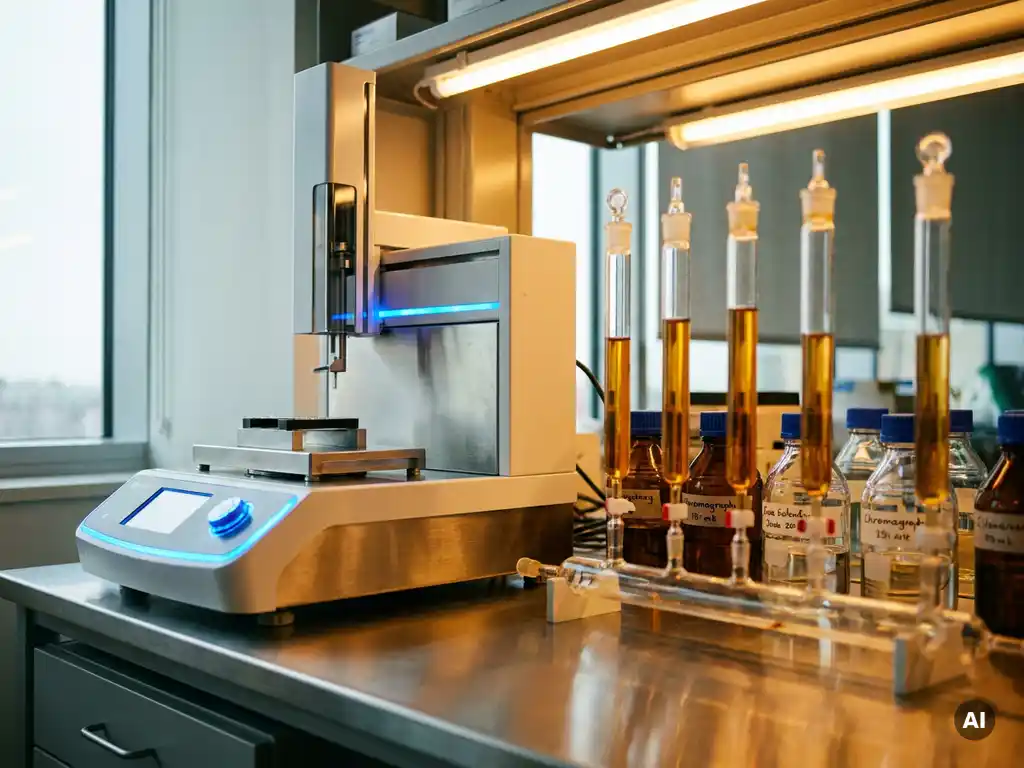
Offline automated sample preparation processes samples in discrete, sequential steps that are physically separated from the analytical instrument, while online automated sample preparation integrates the preparation steps directly with the instrument so that extraction, cleanup, and analysis occur in a continuous, connected workflow. The choice between the two depends on sample volume, matrix complexity, throughput demands, and the target contaminants. The sections below walk through how each mode works, where each performs best, and how to decide which approach fits your laboratory’s needs.
How do offline and online sample preparation systems actually work?
In offline automated sample preparation, each step of the workflow, extraction, cleanup, concentration, and fractionation, is carried out on a dedicated instrument or workstation that operates independently from the analytical instrument. Prepared extracts are collected, stored if necessary, and then transferred to the GC, LC, or MS system for measurement. In online systems, the sample preparation module is directly coupled to the analytical instrument, so the extract flows straight into the detector without any intermediate handling.
Offline systems typically follow a defined sequence: a sample is loaded onto an extraction platform such as an automated SPE system, solvents are applied, fractions are collected, and the extract is concentrated before injection. Each stage can be optimized independently, and the operator can inspect or archive intermediate fractions. This separation of preparation from analysis gives laboratories a high degree of flexibility and control over each individual step.
Online systems, by contrast, automate the transfer between preparation and detection. A valve or switching module directs the extract from the cleanup cartridge or column directly onto the analytical column. This eliminates the manual transfer step and reduces the risk of sample loss or contamination during handling. However, it also means that the preparation chemistry must be fully compatible with the downstream analytical conditions, which places tighter constraints on method development.
What types of samples and contaminants suit each approach?
Offline automated sample preparation is better suited to complex, high-matrix samples such as food, feed, soil, sewage sludge, and biological tissue, where extensive cleanup is required before the extract is clean enough for injection. Online automated sample preparation is more appropriate for relatively clean matrices such as drinking water or aqueous environmental samples, where the sample can be loaded directly onto a sorbent and transferred to the analytical system with minimal intermediate treatment.
For persistent organic pollutants, dioxins, PCBs, PBDEs, and PCNs, the matrix is almost always complex. Lipids, sulfur, and other co-extractants must be removed through multi-layer column cleanup before the extract reaches the detector. This multi-step purification is difficult to integrate inline without compromising analytical performance, which is why offline platforms dominate this space. Fully automated cleanup systems for POPs are designed specifically to handle this complexity in a controlled, sequential manner.
PFAS analysis in water matrices, on the other hand, is a case where online or near-online SPE approaches have gained traction, particularly for large-volume water samples where concentration factors are needed but the matrix itself is relatively straightforward. Pesticide residue analysis in food extracts can sit in either camp depending on the regulatory method and the degree of cleanup required.
Which approach offers better throughput for high-volume labs?
For high-volume laboratories, offline automated sample preparation generally delivers superior throughput because preparation instruments and analytical instruments operate independently and in parallel. While the GC-MS or LC-MS is running one batch of injections, the offline SPE or cleanup system can be preparing the next batch simultaneously. This decoupling of preparation from analysis is the single most important throughput advantage of the offline mode.
Online systems, by contrast, tie up the analytical instrument during the preparation phase. If the online cleanup step takes 20 minutes per sample and the analytical run takes 60 minutes, the instrument is unavailable for other work during the preparation portion of each cycle. For low-volume or research settings this is rarely a problem, but for contract laboratories or monitoring programs processing dozens or hundreds of samples per week, the bottleneck becomes significant.
Modern offline SPE platforms address throughput directly through parallel processing. Systems designed for simultaneous multi-channel extraction can process multiple samples at once across several cartridge positions. Platforms capable of running up to 80 samples in a single run across consecutive sequences of eight samples demonstrate how offline automation can dramatically compress turnaround times without sacrificing cleanup quality. Paired with automated concentration steps, these platforms allow a laboratory to maintain continuous instrument utilization across shifts.
How do offline and online systems compare for PFAS and POPs analysis?
For POPs analysis, dioxins, PCBs, and PBDEs, offline automated systems are the established standard because the required multi-layer column cleanup cannot be reliably replicated in an inline format. For PFAS analysis, both approaches are used, but the choice depends on the matrix: offline SPE is preferred for complex food and sediment matrices, while online or large-volume automated extraction is well suited for water samples where high concentration factors are needed and the matrix is relatively clean.
POPs in food and feed require removal of lipids, sulfur compounds, and other co-extractants through a sequence of cleanup columns, typically activated carbon, alumina, and silica-based materials in combination. Automating this sequence offline preserves the integrity of each cleanup stage and allows the operator to verify intermediate fractions. The GO-EHT systems from Miura, distributed by DSP-Systems, are purpose-built for exactly this workflow, using less than 100 ml of solvent per sample and eliminating dichloromethane from the process entirely.
PFAS analysis presents a different challenge: ultra-trace detection in water requires large-volume extraction to achieve the necessary concentration factors, and the absence of Teflon in the flow path is critical to avoid background contamination. Offline automated SPE systems for water address both requirements by supporting large disk formats and featuring inert, Teflon-free flow paths. For PFAS in solid matrices such as soil or food, offline SPE with cartridge-based cleanup remains the preferred approach because of the additional matrix removal steps involved.
What are the main limitations of each sample preparation mode?
The main limitation of offline automated sample preparation is the additional hands-on time and infrastructure required to manage samples between steps, loading, unloading, and transferring extracts between instruments adds logistical complexity compared to a fully inline workflow. The main limitation of online automated sample preparation is its restricted applicability to complex matrices, where insufficient cleanup before injection can suppress signals, contaminate the analytical column, or produce non-compliant results.
Offline systems also require more laboratory space, as separate instruments handle extraction, cleanup, and concentration. Capital investment is spread across multiple platforms rather than a single coupled system. However, this modularity is also an advantage: each component can be upgraded or replaced independently, and the failure of one instrument does not take the entire analytical workflow offline.
Online systems are inherently less flexible. Method changes that alter the cleanup chemistry may require hardware modifications to the switching valve or inline cartridge configuration. If the analytical instrument requires maintenance or calibration, the entire coupled system is unavailable, which can create scheduling pressure in high-throughput environments. Online approaches also tend to require more rigorous method development upfront to ensure that the inline cleanup is sufficient for the target analytes and matrix combination.
When should a lab choose offline over online automated preparation?
A laboratory should choose offline automated sample preparation when it is analyzing complex matrices, working with persistent organic pollutants that require multi-step column cleanup, running high sample volumes that benefit from parallel preparation and analysis, or operating under regulatory methods that specify discrete cleanup procedures. Online preparation is the better choice when the matrix is simple and aqueous, sample volumes are modest, and speed of result delivery for individual samples outweighs the need for batch throughput.
Regulatory context also matters. Many official methods for dioxins and PCBs, including EPA 1613B and EPA 1668A, describe specific cleanup sequences that are most straightforwardly implemented in an offline, step-by-step format. Demonstrating compliance with these methods is easier when each cleanup stage is documented and verifiable, which offline systems naturally support through fraction collection and intermediate checkpoints.
Laboratories that process a diverse range of sample matrices, soil one week, food the next, water the week after, will find offline systems more adaptable because the extraction and cleanup modules can be reconfigured without altering the analytical instrument setup. For specialized water testing laboratories running a single, well-characterized PFAS method at scale, an online or near-online approach may streamline operations and reduce per-sample costs. The decision ultimately comes down to matrix diversity, regulatory method requirements, and whether throughput is best served by parallel batch processing or continuous inline analysis.
How DSP-Systems supports your automated sample preparation workflow
DSP-Systems provides specialized automated sample preparation solutions for laboratories analyzing environmental contaminants across both offline and, where applicable, online workflows. Whether your priority is POPs cleanup, PFAS extraction from water, or high-throughput SPE for pesticides and emerging contaminants, DSP-Systems offers a portfolio of purpose-built systems backed by deep application expertise. Key capabilities include:
- GO-EHT automated cleanup systems for dioxins, PCBs, PBDEs, and PCNs across food, feed, soil, sludge, water, and air, using less than 100 ml of solvent per sample with no dichloromethane and no cross-contamination risk
- SPE2000 and AutoEmpore platforms for high-throughput offline SPE of PFAS, pesticides, hormones, PAHs, and SVOCs, with Teflon-free inert flow paths suited to ultra-trace analysis
- SER-158 extraction system for solid and semi-solid matrices, fully compatible with GO-EHT cleanup for an integrated, end-to-end offline workflow
- Pre-installation programming, SPE application testing, and configuration aligned with EPA and CEN regulatory standards
- Method development support, training, and turnkey laboratory setup for laboratories building or scaling contaminant analysis capabilities
If you are evaluating automated sample preparation systems or need guidance on which approach fits your laboratory’s matrices and throughput requirements, contact DSP-Systems to speak with a specialist.
Veelgestelde vragen
How do I validate that my offline automated cleanup is sufficient before moving to full-batch processing?
Start by running a set of matrix-matched reference standards and certified reference materials (CRMs) through the full offline workflow, including extraction, cleanup, and concentration, before committing to batch runs. Check recoveries, reproducibility, and signal suppression against your method acceptance criteria. For POPs methods like EPA 1613B, isotope-dilution internal standards provide an additional layer of validation because they track losses at every stage of the offline process.
Can offline and online sample preparation approaches be combined in the same laboratory workflow?
Yes, and in practice many laboratories use a hybrid strategy. For example, a lab might use an offline automated SPE platform for complex food and soil matrices while running an online or near-online SPE setup on a dedicated LC-MS line for high-volume drinking water PFAS screening. The key is to match the preparation mode to the matrix and throughput requirements of each method rather than forcing a single approach across all sample types.
What are the most common mistakes labs make when transitioning from manual to automated offline sample preparation?
The most frequent mistakes are directly transferring manual method parameters, such as flow rates, solvent volumes, and conditioning steps, into the automated method without reoptimization, and underestimating the importance of cartridge-to-cartridge consistency at scale. Automated systems can expose variability that manual steps mask through operator adjustment. Always revalidate recovery and precision after automation, and use the system’s logging and fraction-tracking features to catch drift early.
How much solvent reduction can realistically be achieved by switching to automated offline SPE compared to manual methods?
Modern automated offline SPE platforms routinely reduce solvent consumption by 50–80% compared to manual SPE or liquid-liquid extraction workflows, primarily by eliminating over-conditioning, optimizing elution volumes, and removing the solvent waste associated with manual transfers. Purpose-built cleanup systems for POPs, such as the GO-EHT, are designed to use less than 100 ml per sample with no dichloromethane, which also reduces waste disposal costs and improves laboratory safety.
What should I look for in an automated sample preparation system if my lab handles multiple contaminant classes and matrix types?
Prioritize modularity and method flexibility: the system should support interchangeable cartridge formats, adjustable flow rates, and programmable solvent sequences so that a single platform can handle SPE for PFAS, pesticide cleanup, and PAH extraction without hardware changes. Teflon-free inert flow paths are important if PFAS is in scope, and the system should have robust logging and traceability features to support multi-method regulatory compliance. Vendor application support and the availability of pre-validated method libraries for your target analytes are also critical evaluation criteria.
How do I estimate the return on investment when justifying an automated offline sample preparation system to laboratory management?
Build the ROI case around four factors: analyst time saved per sample, increased instrument utilization through parallel preparation and analysis, reduction in reruns caused by manual handling errors, and solvent and consumable cost savings. For a lab processing 50 or more complex matrix samples per week, the labor savings alone typically justify the capital investment within one to two years, and the reduction in failed batches due to contamination or inconsistent cleanup adds further measurable value.
Is it possible to meet EPA 1613B or EPA 1668A compliance requirements using a fully automated offline cleanup system?
Yes, fully automated offline cleanup systems can be configured to replicate the sequential column cleanup steps specified in EPA 1613B and EPA 1668A, including activated carbon, alumina, and silica-based fractionation, in a documented, reproducible manner. The key compliance advantage of offline automation is that each fraction can be collected, logged, and verified independently, which directly supports the documentation requirements of these methods. Working with a vendor that offers pre-installation programming aligned to EPA and CEN standards significantly reduces the method development burden.
Gerelateerde artikelen
- What are the risks of poorly automated sample preparation in regulated labs?
- Can automation help labs handle seasonal spikes in sample volume?
- What types of samples can be processed with automation?
- Why is laboratory automation important for modern analytical labs?
- What laboratory workflows benefit most from automation?
Deze inhoud is gegenereerd met behulp van AI en kan fouten bevatten.