
What is the difference between modular and monolithic lab automation systems?
Modular lab automation systems are easier to scale, more flexible to reconfigure, and lower in upfront cost, while monolithic systems offer tighter integration and higher throughput for fixed, high-volume workflows. The right choice depends on how stable your analytical menu is, how much your sample volumes fluctuate, and whether your laboratory expects to add new contaminant targets over time. The questions below unpack each dimension of this decision in detail.
Which type of lab automation system is easier to scale?
Modular lab automation systems are significantly easier to scale. Because each functional unit operates independently and connects to others through standardized interfaces, laboratories can add capacity or new capabilities one module at a time without replacing the entire platform. This incremental approach aligns capital investment with actual workload growth rather than requiring a large upfront commitment.
Monolithic systems, by contrast, are engineered as a single integrated unit. Scaling them typically means purchasing a second complete system or migrating to a larger model, both of which involve substantial cost and downtime. For laboratories that process predictable, high volumes of a fixed sample type, this is rarely a problem. But for labs whose workload grows in steps or whose analytical scope expands over time, the inability to add a single module without replacing the whole platform is a meaningful constraint.
The scalability advantage of modular architecture becomes especially clear in environmental testing laboratories, where new regulatory targets such as PFAS compounds or emerging persistent organic pollutants are regularly added to monitoring programs. A modular platform can absorb a new extraction or cleanup module without disrupting existing workflows, whereas a monolithic system may require a full method revalidation or hardware replacement to accommodate the change.
What are the main components of a modular lab automation system?
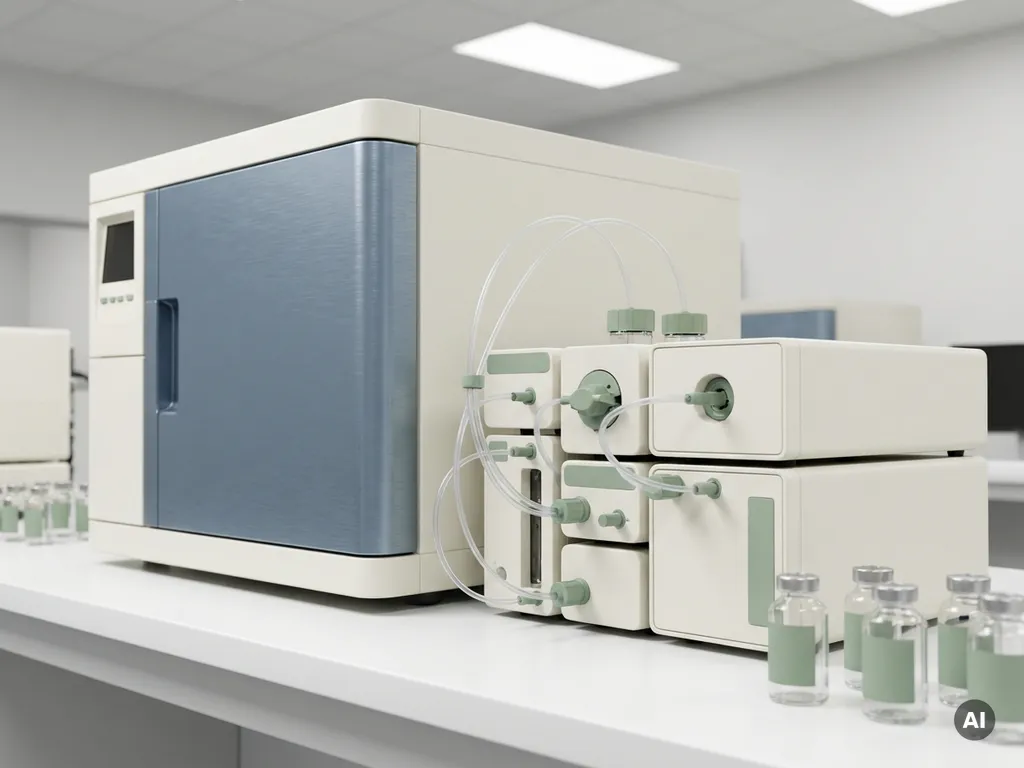
A modular lab automation system is built from discrete, interchangeable functional units that each handle a specific stage of the sample preparation workflow. Common components include extraction modules, cleanup or purification units, concentration systems, fraction collection modules, and a central software controller that coordinates the sequence of operations across all connected units.
In practice, a typical modular setup for environmental contaminant analysis might include:
- Extraction module: Handles initial isolation of target analytes from the sample matrix, using techniques such as solid-phase extraction (SPE) or solvent-based extraction.
- Cleanup or purification module: Removes co-extracted matrix interferences such as lipids, sulfur, or other organic compounds that would otherwise suppress or distort instrument signals.
- Concentration module: Reduces solvent volume to the precise end volume required for instrument injection, using vacuum centrifugation, nitrogen blowdown, or parallel evaporation.
- Fraction collector: Separates analyte classes into defined fractions for targeted analysis.
- Software interface: Provides centralized control, sequence programming, and audit trail logging across all modules.
The defining characteristic of a modular system is that each of these components can be sourced, upgraded, or replaced independently. A laboratory can invest in a high-capacity automated SPE system without committing to a fully integrated platform, then add purification and concentration modules as throughput demands increase.
How do modular and monolithic systems compare on total cost of ownership?
Monolithic systems typically carry a higher upfront purchase price but may offer lower per-sample costs at high throughput, while modular systems have a lower entry cost but accumulate expense as modules are added. Over a five-to-ten-year horizon, total cost of ownership depends heavily on how the laboratory’s workload evolves, not just on the initial purchase price.
Several factors shape the long-term cost comparison:
- Maintenance and repair: When a monolithic system fails, the entire workflow stops. A modular system allows other units to continue operating while one module is serviced, reducing costly downtime.
- Obsolescence risk: Monolithic platforms can become outdated as a whole when one component reaches end of life. Modular systems allow individual components to be updated without replacing functional parts of the system.
- Solvent and consumable costs: Systems that reduce organic solvent consumption lower both direct material costs and waste disposal costs. This is a meaningful ongoing saving, particularly for laboratories running large numbers of samples for dioxins, PCBs, or PFAS analysis.
- Retraining and revalidation: Swapping a module in a modular system generally requires less revalidation effort than migrating to a new monolithic platform, which can require full method revalidation to satisfy ISO 17025 or regulatory requirements.
Laboratories should build a cost model that includes not just hardware acquisition but also consumables, maintenance contracts, downtime risk, and the cost of revalidation when the system needs to change.
When should a laboratory choose a monolithic system instead?
A laboratory should choose a monolithic system when it processes a high, stable volume of a single sample type using a fixed analytical method, and when maximum throughput and tight system integration are more important than flexibility. Monolithic platforms excel in environments where the workflow is well-defined, regulatory methods are locked, and the primary goal is processing as many samples as possible per shift.
Specific situations that favor a monolithic approach include:
- National reference laboratories or large contract labs running thousands of identical samples per year under a single accredited method.
- Laboratories where the analytical menu is unlikely to change, eliminating the need for modular reconfigurability.
- Settings where a single vendor’s integrated system has been validated end to end for a specific regulatory method, reducing the burden of cross-component validation.
- High-throughput food safety monitoring programs with fixed matrices and contaminant targets.
The key question is not which architecture is objectively better, but which one matches the laboratory’s operational reality. A monolithic system purchased for a stable, high-volume workflow will outperform a modular system on per-sample cost and throughput. The risk appears when that workflow changes and the system cannot adapt.
How does system architecture affect cross-contamination risk in sample prep?
System architecture has a direct and significant impact on cross-contamination risk. In automated sample preparation, cross-contamination occurs when residues from one sample transfer to the next through shared surfaces, tubing, or fluid pathways. Both modular and monolithic systems can be designed to minimize this risk, but the design principles differ and the consequences of poor design are more severe in high-sensitivity contaminant analysis.
The most effective contamination control strategy is eliminating direct contact between the sample and the system’s internal components entirely. Fully automated purification platforms that process each sample through dedicated, single-use or thoroughly inert pathways eliminate the primary route of carryover. This is particularly critical when analyzing persistent organic pollutants such as dioxins, PCBs, and PFAS, where contamination at trace levels can invalidate results or trigger false regulatory exceedances.
Several architectural features reduce cross-contamination risk regardless of whether the system is modular or monolithic:
- Inert flow paths: Materials that do not absorb or release analytes, and that are resistant to all organic solvents, prevent residue buildup between samples. For PFAS analysis in particular, Teflon-free inert flow paths are essential.
- No direct sample-to-system contact: Systems where the sample matrix never touches reusable internal surfaces eliminate the primary carryover mechanism.
- Automated cleaning sequences: Programmed solvent flushes between samples reduce residual contamination without relying on manual cleaning steps.
- Separate fraction collection: Dedicated collection vessels for each sample prevent cross-sample mixing during the concentration or fraction collection stage.
When evaluating any automated sample preparation system, laboratories should request detailed documentation of how the system manages carryover, particularly for their specific analyte classes and matrices.
What questions should labs ask before choosing an automation platform?
Before selecting a lab automation platform, laboratories should ask questions that reveal whether the system matches their current workflow, their growth trajectory, and their regulatory obligations. The wrong platform chosen on the basis of purchase price alone can result in years of operational constraint and avoidable revalidation costs.
The most important questions to ask include:
- What is our analytical menu today, and how likely is it to expand? If new contaminant targets are expected within the next three to five years, modular architecture offers a clear advantage.
- How variable is our sample volume? Laboratories with seasonal or project-driven throughput fluctuations benefit from systems that can scale up or down without idle capacity.
- What matrices do we process? Some systems are optimized for aqueous samples, others for solid matrices such as soil, sludge, or food. Confirm that the platform has been validated for your specific matrices.
- What are our solvent reduction and sustainability targets? Systems that operate below 100 mL of organic solvent per sample without dichloromethane reduce both environmental impact and waste disposal costs significantly.
- What does the vendor offer beyond hardware? Pre-installation programming, application testing, method development support, and training are often as important as the system itself for laboratories building or scaling internal capabilities.
- How does the system support ISO 17025 compliance? Audit trail functionality, software validation documentation, and compatibility with existing accredited methods are non-negotiable for accredited laboratories.
- What is the true cost of downtime? Ask vendors for realistic service response times and whether the system architecture allows partial operation during maintenance.
Taking time to answer these questions internally before engaging vendors puts laboratories in a much stronger position to evaluate proposals critically rather than defaulting to the most familiar brand or the lowest quoted price.
How DSP-Systems helps laboratories choose the right automation architecture
DSP-Systems works directly with environmental testing laboratories, food safety labs, and ISO 17025-accredited facilities across Europe and North America to match the right automation architecture to each laboratory’s specific workflow, regulatory obligations, and growth plans. Their offering addresses both modular and integrated approaches to sample preparation:
- The GO-EHT fully automated purification platform for dioxins, PCBs, PBDEs, and PCNs across food, feed, soil, water, and air matrices, using less than 100 mL of solvent per sample and eliminating cross-contamination through a no-direct-contact design.
- The SPE2000 and AutoEmpore automated SPE systems for high-throughput extraction of PFAS, pesticides, hormones, and other emerging contaminants, with fully inert, Teflon-free flow paths.
- The SER-158 solvent extractor for solid and semi-solid matrices, seamlessly compatible with GO-EHT cleanup systems for an integrated end-to-end workflow.
- Pre-installation programming, SPE application testing, and configuration aligned with EPA and CEN standards.
- Method development and validation support, training, and turnkey laboratory setup services.
Whether you are evaluating your first automated system or reconsidering an existing platform, DSP-Systems provides the technical expertise to guide that decision. Contact their team to discuss your laboratory’s requirements and find the configuration that fits.
Veelgestelde vragen
How do I know if my current manual sample prep workflow is ready to be automated?
A workflow is typically ready for automation when it is well-documented, reproducible, and performed repeatedly on similar sample types — meaning the steps can be reliably translated into a programmed sequence. Key indicators include high sample volumes consuming significant analyst time, frequent manual errors or variability between technicians, or pressure to reduce solvent use and improve traceability. Before approaching vendors, document your current method step by step, including volumes, contact times, and solvent sequences, so you can evaluate whether a candidate system can replicate or improve on each stage.
Can a modular system be validated to ISO 17025 standards, or does modular architecture create compliance complications?
Modular systems can absolutely be validated to ISO 17025 standards, but the validation strategy requires careful planning, particularly when modules from different vendors are combined. Each module’s contribution to measurement uncertainty must be characterized, and the integrated sequence must be validated as a whole for the specific matrices and analytes in scope. The advantage is that when a single module is upgraded or replaced, revalidation can often be scoped to that module’s function rather than the entire method, provided the rest of the workflow remains unchanged — a significant time and cost saving compared to revalidating a fully replaced monolithic platform.
What are the most common mistakes laboratories make when selecting a lab automation platform?
The most common mistake is optimizing for current workload rather than anticipated workload over a three-to-five-year horizon, which leads to either overpaying for capacity that goes unused or purchasing a system that cannot accommodate new analytes or matrices when regulatory requirements expand. A second frequent error is underestimating the total cost of ownership by focusing on hardware acquisition price while overlooking consumables, solvent disposal, service contracts, downtime risk, and revalidation costs. Finally, many laboratories fail to confirm that the platform has been validated for their specific matrices — a system proven on aqueous environmental samples may perform very differently on lipid-rich food matrices or solid soil samples.
How should laboratories handle the transition period when switching from manual to automated sample preparation?
The most effective approach is to run the automated and manual methods in parallel on a defined set of representative samples before fully decommissioning the manual workflow, allowing direct comparison of recoveries, precision, and any matrix-specific differences. This parallel validation phase also gives analysts time to build confidence with the new system and identify any method adjustments needed before the automated workflow is used for reportable results. Engaging the vendor’s application support team during this period — for pre-installation programming, method optimization, and initial troubleshooting — significantly reduces the risk of delays and accelerates the transition to full operational use.
Is it possible to automate only part of the sample preparation workflow and keep other steps manual?
Yes, and for many laboratories this is the most practical starting point, particularly when budget, space, or method complexity makes full automation difficult to justify immediately. A common approach is to automate the most time-intensive or error-prone step first — such as SPE extraction or solvent concentration — while keeping upstream or downstream steps manual. The key consideration is ensuring that the interface between automated and manual steps does not introduce variability or contamination risk that undermines the precision gains from automation; this requires careful attention to handoff points such as sample transfer volumes, vessel compatibility, and timing.
How do solvent reduction capabilities vary between modular and monolithic systems, and why does it matter?
Solvent consumption is largely a function of the specific extraction and cleanup technology used rather than the modular-versus-monolithic architecture itself, but modular systems offer the advantage of allowing laboratories to select individual modules optimized for low-solvent operation and combine them into a custom workflow. Modern automated purification platforms can process samples using less than 100 mL of organic solvent, compared to several hundred milliliters for traditional manual methods — a reduction that directly lowers reagent costs, waste disposal fees, and analyst exposure to hazardous solvents. For laboratories running high volumes of dioxin, PCB, or PFAS analyses, the cumulative cost and regulatory impact of solvent reduction over thousands of samples per year is a meaningful financial and sustainability argument in the platform selection decision.
What should laboratories ask vendors specifically about cross-contamination control before purchasing?
Ask vendors to provide carryover data for your specific analyte classes and matrices — not just generic performance claims — ideally demonstrated by spiking a high-concentration sample followed immediately by a blank and measuring residual signal. Specifically probe whether any internal surfaces that contact the sample are reused across samples, what cleaning protocols are programmed between runs, and what materials are used in all fluid-contact components (this is especially critical for PFAS analysis, where Teflon-containing components can be a source of background contamination). Requesting references from laboratories already running your target analytes on the same platform is the most reliable way to validate vendor claims before committing to a purchase.
Gerelateerde artikelen
- What consumables are required for automated sample preparation systems?
- What is the difference between automated and manual sample preparation?
- What is solvent extraction in automated sample preparation?
- Why is automated sample preparation important in analytical labs?
- How do automated systems handle diverse sample matrices?
Deze inhoud is gegenereerd met behulp van AI en kan fouten bevatten.