
How do food safety labs use automated sample preparation systems?
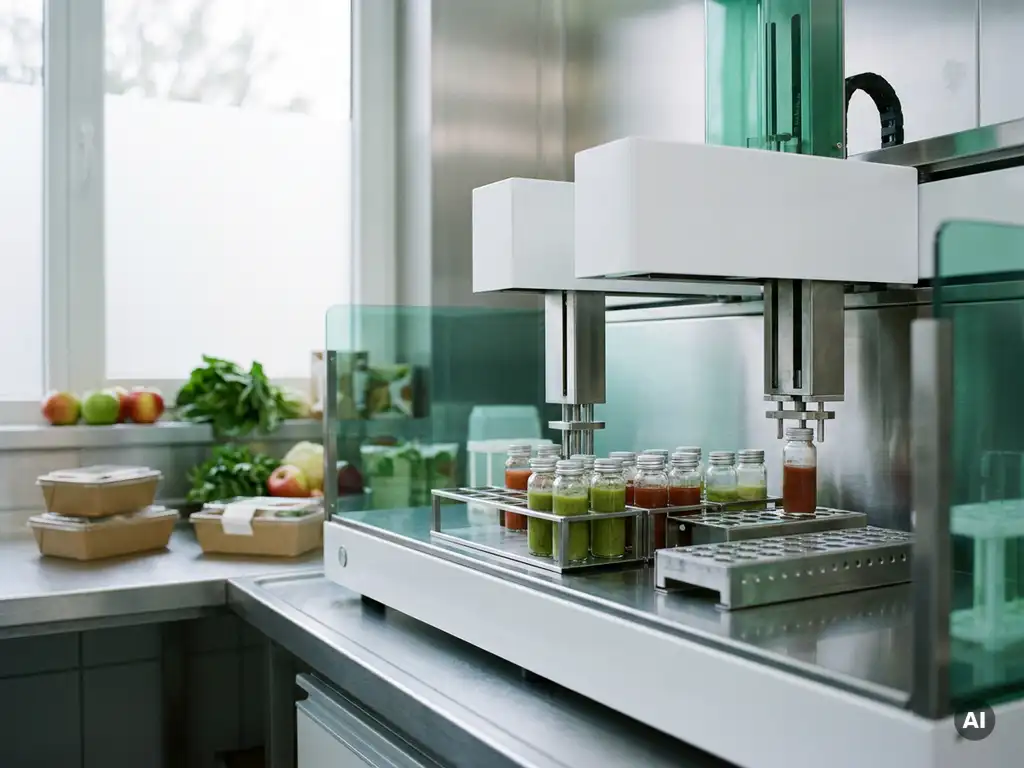
Food safety labs use automated sample preparation systems to extract, purify, and concentrate samples before instrumental analysis of contaminants such as dioxins, PCBs, and PFAS. These systems replace labor-intensive manual steps with programmable, reproducible workflows that handle everything from solvent extraction through multi-layer cleanup. The questions below walk through exactly how this automation works, which systems are involved, and when outsourcing makes sense.
What types of contaminants do food safety labs test for?
Food safety laboratories routinely test for persistent organic pollutants (POPs) including dioxins (PCDD/Fs), polychlorinated biphenyls (PCBs), polybrominated diphenyl ethers (PBDEs), per- and polyfluoroalkyl substances (PFAS), and pesticides. These contaminants accumulate in food and feed matrices such as meat, fish, eggs, dairy, cereals, and vegetable oils, and are subject to strict regulatory limits in the EU and internationally.
Beyond POPs, food safety labs also screen for polycyclic aromatic hydrocarbons (PAHs), mycotoxins, mineral oils, and hormones. The analytical challenge is that these compounds occur at trace or ultra-trace concentrations in highly complex matrices that contain large amounts of co-extracted lipids, proteins, and other interferences. Before any instrument measurement can take place, the sample must be cleaned up thoroughly enough to isolate the target analytes from everything else. This is precisely where sample preparation becomes the rate-limiting step in a laboratory’s workflow.
Regulatory frameworks such as EU Commission Regulation 2023/915 on maximum levels for dioxins and PCBs in food and feed set binding limits that require validated, sensitive analytical methods. Meeting those limits consistently demands not just the right instrumentation but a reproducible, contamination-free preparation process upstream of the detector.
How does automated sample preparation work in food testing?
Automated sample preparation in food testing follows a sequence of extraction, cleanup, and concentration steps that are executed by programmable instruments rather than by hand. The sample is first extracted using a solvent or solid-phase medium to transfer target analytes out of the food matrix, then passed through one or more purification stages to remove lipids and other co-extractants, and finally concentrated to the injection volume required by the analytical instrument.
Extraction
For solid and semi-solid food matrices such as meat, fish meal, or feed, solvent extraction is typically the first step. Systems based on the Randall principle perform extraction directly in boiling solvent followed by a hot Soxhlet or Twisselmann phase, achieving high analyte recovery while keeping solvent volumes low. Up to six samples can be processed in a single run using less than 100 mL of solvent per sample, and the solvent is simultaneously recovered for reuse.
Purification and cleanup
Once extracted, the crude extract contains large quantities of co-extracted lipids that must be removed before mass spectrometry measurement. Automated cleanup platforms pass the extract through a series of sorbent columns, typically including silica, alumina, and activated carbon layers, under computer-controlled conditions. The system selects which fractions to collect and discard based on the programmed method, eliminating the operator decisions that introduce variability in manual workflows. Because the sample does not come into direct contact with the instrument’s internal surfaces in fully enclosed systems, the risk of cross-contamination between samples is eliminated.
Concentration
After purification, the collected fractions are evaporated to a precise end volume before injection. Vacuum centrifuges, nitrogen blowdown evaporators, and parallel evaporation systems all serve this role, with the choice depending on sample volume, throughput requirements, and whether the analytes are heat-sensitive.
What are the benefits of automation over manual sample prep in food labs?
Automation delivers four core advantages over manual sample preparation in food safety labs: higher throughput, better reproducibility, reduced solvent consumption, and lower contamination risk. Each of these directly affects both the quality of analytical results and the operating cost of the laboratory.
- Throughput: Automated systems can run overnight or over weekends without operator attendance, dramatically increasing the number of samples processed per working day. High-capacity SPE platforms can handle up to 80 samples in a single unattended run.
- Reproducibility: Every sample follows an identical sequence of steps at identical flow rates, temperatures, and timings. This removes the between-analyst variability that is one of the most common sources of measurement uncertainty in manual workflows.
- Reduced solvent use: Modern automated cleanup systems for dioxins and PCBs operate with less than 100 mL of organic solvent per sample and eliminate the need for dichloromethane, a solvent with significant health and environmental concerns. This reduces both reagent costs and waste disposal obligations.
- Contamination control: In enclosed automated systems, samples never contact shared surfaces between runs, and the risk of airborne or carryover contamination from adjacent samples is structurally eliminated rather than managed through operator discipline.
- Staff efficiency: Analysts are freed from repetitive pipetting and column-packing tasks and can focus on method development, data review, and quality assurance activities that genuinely require expert judgment.
For ISO 17025-accredited laboratories, the reproducibility and traceability benefits of automation also simplify the documentation burden associated with demonstrating measurement uncertainty and method performance to accreditation bodies.
Which automated systems are used for dioxin and PFAS analysis in food labs?
Food safety labs analyzing dioxins, PCBs, and PFAS use different automated systems because the two contaminant classes have fundamentally different physicochemical properties and therefore require different cleanup chemistries and materials. Dioxin and PCB analysis demands multi-layer column purification, while PFAS analysis requires inert flow paths free of fluoropolymers to prevent background contamination.
Systems for dioxin and PCB analysis
Fully automated cleanup platforms such as the GO-EHT series from Miura Institute of Environmental Science are specifically designed for the purification of dioxins, PCBs, PBDEs, and polychlorinated naphthalenes (PCNs) across food, feed, soil, and other matrices. These systems automate the entire column cleanup sequence, from lipid removal through fraction collection, and have been validated in peer-reviewed studies for compliance with EU analytical criteria for PCDD/Fs and PCBs in food and feed. For the extraction step upstream of cleanup, solvent extraction systems operating on the Randall principle handle solid food matrices efficiently while minimizing solvent volumes.
Systems for PFAS analysis
PFAS analysis in food and water matrices requires automated solid-phase extraction using equipment with fully inert flow paths. Any contact with Teflon or other fluoropolymer components introduces PFAS background that can mask or inflate results. Automated SPE systems designed for PFAS work use inert materials throughout and support large-volume extraction, which is often necessary to reach the low reporting limits required by current regulations. High-capacity platforms processing multiple samples simultaneously are particularly valuable for food safety labs running large monitoring batches.
How do food labs validate methods for automated sample preparation?
Food safety labs validate automated sample preparation methods by demonstrating that the complete analytical procedure, from extraction through cleanup to final measurement, meets defined performance criteria for recovery, repeatability, reproducibility, linearity, and selectivity. Validation for food contaminant analysis is typically conducted against the requirements of EU Commission Regulation 2021/808 or equivalent frameworks, and must be documented to the standard expected by ISO 17025 accreditation bodies.
The key validation parameters for automated sample preparation specifically include:
- Recovery: Isotopically labeled internal standards are added before extraction, and their recovery through the automated cleanup sequence confirms that the method captures the target analytes quantitatively and consistently.
- Repeatability and within-lab reproducibility: The same sample is processed on multiple occasions, by different analysts if possible, to confirm that the automated system delivers equivalent results regardless of who initiates the run.
- Matrix effects: Different food matrices, such as high-fat fish versus low-fat cereal, can behave differently through the same cleanup method. Validation must cover the matrix range the lab intends to analyze.
- Ruggedness: Small deliberate changes to method parameters, such as solvent volumes or flow rates, are tested to confirm that the method is not sensitive to minor operational variation.
Published validation data for automated systems exist in the scientific literature. Studies have evaluated fully automated sample preparation against EU analytical criteria for PCDD/Fs and PCBs in feed and food, confirming that automated workflows can meet or exceed the performance requirements set for manual reference methods. Method development support from equipment suppliers, including pre-configured methods aligned with EPA and CEN standards, can significantly shorten the time needed to reach a validated state.
When should a food safety lab outsource sample preparation?
A food safety lab should consider outsourcing sample preparation when it lacks the instrumentation, validated methods, or analytical throughput to handle a specific contaminant class in-house, when sample volumes are temporarily too high to process within available capacity, or when the cost of building internal capability for an infrequent analysis type cannot be justified against the volume of work.
Outsourcing is particularly common in three scenarios. First, when a lab receives a one-off or project-based requirement for a contaminant it does not routinely test, such as dioxins or PFAS, and investing in dedicated cleanup instrumentation for that volume would not be economically rational. Second, when an existing lab is scaling up and needs analytical capacity while its own equipment procurement and method validation are still in progress. Third, when a lab requires internationally recognized reports, for example for regulatory submissions or export certification, and working through an ISO 17025-accredited partner provides the required credibility faster than establishing accreditation internally.
The decision to outsource should weigh the cost and lead time of external analysis against the long-term benefit of building internal capability. For laboratories that anticipate sustained, growing demand for contaminant analysis, investing in automated sample preparation systems and in-house method validation typically delivers a better return over time than permanent outsourcing.
How DSP-Systems supports food safety laboratory automation
DSP-Systems supplies and supports the automated sample preparation technologies that food safety labs rely on for dioxin, PCB, PFAS, and pesticide analysis. Their offering covers the full preparation workflow:
- The GO-EHT automated cleanup systems for dioxins, PCBs, PBDEs, and PCNs in food and feed matrices, using less than 100 mL of solvent per sample without dichloromethane
- Automated SPE platforms including the SPE2000 and AutoEmpore for PFAS, pesticides, hormones, and other emerging contaminants, with inert flow paths free of fluoropolymers
- The SER-158 solvent extractor for solid and semi-solid food matrices, fully compatible with GO-EHT cleanup systems
- Method development and validation support, including pre-configured methods aligned with EPA and CEN standards
- Outsourced analytical services through ISO 17025-accredited partner laboratories, available on a temporary or long-term basis
- Certified analytical standards and reference materials for dioxins, PCBs, PFAS, PBDEs, PAHs, and pesticides
Whether your lab is evaluating its first automated cleanup system or looking to expand capacity for PFAS food testing, DSP-Systems provides the technical expertise to match the right solution to your workflow. Contact DSP-Systems to discuss your laboratory’s requirements.
Veelgestelde vragen
How long does it typically take to implement and validate an automated sample preparation system in a food safety lab?
Implementation timelines vary depending on the complexity of the contaminant class and the lab’s existing infrastructure, but most labs can expect 3–6 months from instrument installation to a fully validated, accreditation-ready method. This timeline can be significantly shortened by working with a supplier that offers pre-configured methods aligned with EPA and CEN standards, as this eliminates much of the early-stage method development work. Laboratories already familiar with the target analytes and regulatory criteria tend to move through validation faster, particularly when isotopically labeled internal standards and certified reference materials are already in use.
Can automated sample preparation systems handle multiple contaminant classes in the same lab, or do you need separate instruments for each?
In most cases, separate instruments are needed for different contaminant classes because the cleanup chemistry and materials requirements are fundamentally incompatible. For example, dioxin and PCB analysis requires multi-layer silica, alumina, and activated carbon column cleanup, while PFAS analysis demands fully inert flow paths free of any fluoropolymer components — a requirement that conflicts with the construction of many general-purpose SPE systems. However, a single lab can run both workflows in parallel by housing dedicated instruments for each contaminant class, which is the approach taken by most full-service food safety labs handling a broad analyte portfolio.
What are the most common mistakes labs make when transitioning from manual to automated sample preparation?
The most frequent mistake is assuming that an automated system will compensate for an insufficiently optimized manual method — if the underlying chemistry is flawed, automation will simply reproduce those flaws at higher throughput. A second common issue is underestimating the importance of solvent and reagent purity; at the trace and ultra-trace concentrations typical of dioxin or PFAS analysis, contaminants in solvents or labware can introduce background that compromises results. Finally, labs often overlook the need to re-validate recovery performance across the full range of food matrices they intend to analyze, not just the matrix used during initial method development.
How do automated cleanup systems handle high-fat food matrices like fatty fish or full-fat dairy, which are notoriously difficult to clean up?
High-fat matrices present the greatest cleanup challenge because co-extracted lipids can overwhelm sorbent columns and suppress analyte detection if not fully removed. Modern automated cleanup platforms address this by incorporating a dedicated lipid removal stage — typically a sulfuric acid-impregnated silica or gel permeation chromatography step — before the analytes pass through the selectivity layers. The advantage of automation here is precise control over flow rates and fraction timing, which is critical when lipid loads vary between samples; the system applies the same rigorous conditions to a fatty tuna sample as to a lean chicken breast, whereas a manual analyst may unconsciously adjust technique between samples.
What should a lab look for when evaluating whether an automated sample preparation vendor's system meets EU regulatory requirements?
The most reliable indicator is peer-reviewed validation data demonstrating that the system meets the analytical criteria set out in EU Commission Regulation 2021/808 and the maximum levels defined in Regulation 2023/915 for the relevant contaminant class. Look specifically for published recovery data using isotopically labeled standards across multiple food matrices, and confirm that the system has been used in ISO 17025-accredited laboratories. It is also worth verifying whether the supplier provides pre-configured, documented methods rather than requiring the lab to develop everything from scratch, as this directly affects both time-to-accreditation and the defensibility of the method during external audits.
Is automated sample preparation cost-effective for smaller food safety labs with lower sample volumes?
For labs with consistently low sample volumes, the capital cost of a dedicated automated cleanup system may be difficult to justify against manual processing — but the break-even point is lower than many labs assume once solvent savings, reduced analyst time, and fewer repeat analyses due to contamination or variability are factored in. A practical approach for smaller labs is to start with automation for the highest-complexity or highest-risk contaminant class, such as dioxins or PFAS, where the reproducibility and contamination-control benefits are most critical, and continue processing simpler matrices manually. Alternatively, outsourcing to an accredited partner laboratory for low-frequency analyses preserves cash flow while maintaining access to validated, regulatory-compliant results.
How does nitrogen blowdown compare to vacuum centrifugation for the final concentration step, and does the choice affect analyte recovery?
Both nitrogen blowdown and vacuum centrifugation reduce solvent volume to the required injection volume, but they differ in suitability depending on analyte volatility, sample volume, and throughput needs. Nitrogen blowdown is well-suited to larger solvent volumes and is widely used for dioxin and PCB fractions, but requires careful temperature and flow control to avoid analyte loss through co-evaporation, particularly for lighter congeners. Vacuum centrifugation is gentler and better suited to heat-sensitive analytes or small-volume fractions, and its enclosed format reduces the risk of airborne contamination during concentration — a meaningful consideration in ultra-trace PFAS work where ambient contamination is a known analytical challenge.
Gerelateerde artikelen
- What sample throughput can automated preparation systems realistically achieve?
- What are the data integrity benefits of automated sample preparation?
- What are the risks of poorly automated sample preparation in regulated labs?
- How do you build a business case for laboratory automation in 2026?
- How does automated sample preparation improve lab efficiency?
Deze inhoud is gegenereerd met behulp van AI en kan fouten bevatten.